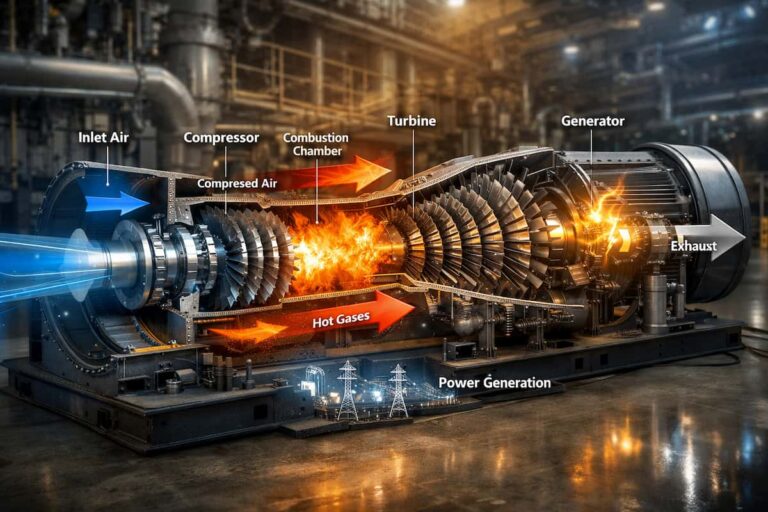
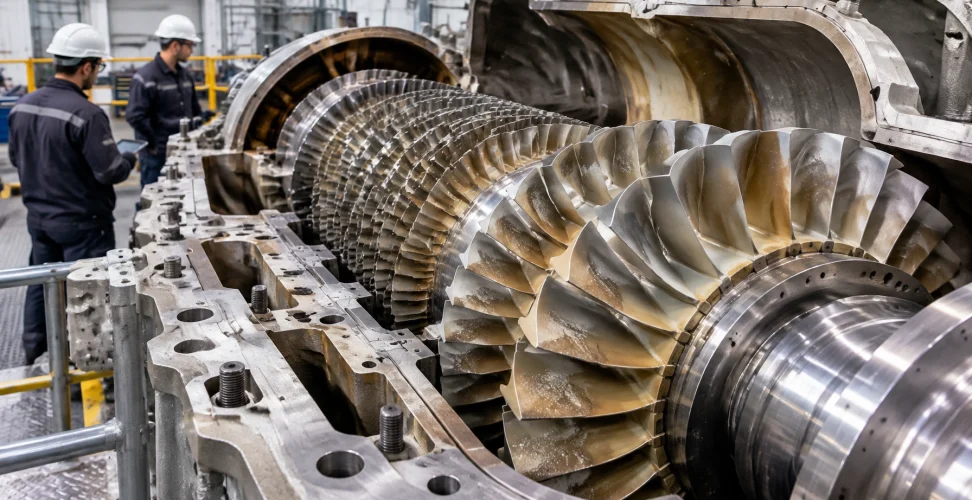
Water chemistry is an invisible part of steam turbine maintenance. It does not appear on a parts list until deposits restrict the steam path or corrosion damages blades, disks, and attachments. By that stage, a chemistry excursion can already have become an expensive outage problem.
As steam expands through a turbine, trace impurities can concentrate in droplets and thin liquid films. These conditions are especially important in the low-pressure turbine’s phase-transition zone (PTZ), where moisture begins to form. Steam purity and shutdown protection directly influence deposit formation, corrosion risk, efficiency, and component life.
Understanding the link between cycle chemistry and component condition helps your operations, chemistry, and maintenance teams respond before a small deviation becomes a major repair. The guidance below draws on the IAPWS Technical Guidance Document on Steam Purity for Turbine Operation. Its targets are guidance, not universal specifications; apply limits suited to your turbine, cycle, materials, and operating conditions.
How Steam Path Corrosion Starts
Impurities can reach turbine steam through boiler-water carryover, contamination in makeup or return condensate, and impurities in attemperation water. As steam expands, some substances become less soluble and can deposit on blades and other flow-path surfaces.
Silica deposits reduce performance
Silica can travel with steam and deposit as conditions change through the turbine. These deposits can restrict steam passages, reduce flow capacity, degrade efficiency, and contribute to axial thrust changes. Silica deposits are not necessarily corrosive by themselves, but they can still impair performance and require cleaning.
IAPWS gives a silica target below 10 μg/kg for condensing utility turbines with superheated steam below 600°C, while noting that each plant should customize its limits. If silica levels trend upward, investigate the source and monitor turbine pressure and performance. Cleaning requirements depend on the deposit’s composition and severity.
Chloride ingress creates a localized corrosion risk
Chloride and sulfate can enter with contaminated water or boiler carryover. In the PTZ, impurities concentrate in droplets and liquid films. During an unprotected shutdown, hygroscopic deposits can absorb moisture from ambient air and form localized corrosive conditions on metal surfaces.
That cycle can initiate pitting: small, localized cavities that act as stress raisers. Repeated exposure can increase the risk of corrosion fatigue and stress corrosion cracking (SCC), particularly in highly stressed blade attachment areas.
Oxygen attack is closely tied to shutdown conditions
The corrosion story is more nuanced than “oxygen in steam causes turbine pitting.” According to IAPWS, oxygen in liquid films during normal turbine operation is generally very low. A major concern is moist air exposure during an unprotected shutdown, when deposits absorb moisture and oxygenated films can form.
For extended shutdowns, layup procedures matter. IAPWS identifies controlled dehumidified-air preservation as a key method for protecting steam-path surfaces. The appropriate approach depends on your equipment and site procedures.
Caustic concentration can damage susceptible areas
Sodium hydroxide and other sodium-bearing contaminants can concentrate in deposits or liquid films. Hot caustic environments may cause severe SCC in susceptible materials under stress. Caustic gouging and under-deposit attack should be evaluated in the context of the specific chemistry, material, and damage pattern rather than assumed from a chemistry reading alone.
Preventing boiler-water carryover and caustic contamination, and investigating deposits found during inspection, can help your team identify the cause before damage progresses.
The Cost Curve: From Chemistry Excursion to Blade Replacement
The cost of poor chemistry tends to rise as damage moves from deposition to permanent material loss:
- Deposits: Early deposits may be removable, depending on their composition, location, and severity. Silica and some other deposits may require mechanical cleaning; other deposits may call for a different approved method.
- Localized corrosion: Pitting removes metal and creates irregular surfaces. It may also provide an initiation site for cracks.
- Cracking or erosion: Corrosion fatigue, SCC, and erosion-corrosion can affect blade integrity and require engineering assessment, repair, or replacement.
- Outage and parts impact: If inspection finds unacceptable damage, repairs may require rotor blades, stator blades, installation hardware, seals, or gaskets, and the time to source them can affect the outage window.
Wet-steam stages of low-pressure turbines face another challenge: water droplets can erode blade surfaces. Erosion-corrosion can involve both mechanical material loss and corrosive conditions in the wet steam path. Unlike some deposits, metal lost to corrosion or erosion is not restored by cleaning.
For maintenance planners, this distinction matters. Cleaning may address certain deposits, but it cannot replace lost material or resolve a crack. Inspection findings and engineering acceptance criteria must guide the response.
Monitoring and Early Detection
A coordinated monitoring program gives chemistry and maintenance teams better information to act on before the next outage.
- Track steam purity. Monitor conductivity after cation exchange (cation conductivity), sodium, and silica using sampling locations and methods appropriate for your plant. IAPWS lists typical normal targets for condensing utility turbines with superheated steam below 600°C of less than 0.20 μS/cm cation conductivity, less than 2 μg/kg sodium, and less than 10 μg/kg silica. Confirm plant-specific limits before using these figures.
- Investigate excursions and transients. Startups, shutdowns, load changes, condenser leakage, boiler carryover, and attemperator operation can all affect steam purity. A trend is often more useful than an isolated reading.
- Check for contaminant sources. Review boiler-water separation, makeup and condensate quality, condenser integrity, and spray-water quality when results point to contamination.
- Use outage inspections to connect chemistry with component condition. Risk-based borescope or internal inspection can look for deposits, pitting, erosion, cracking, and damage at blade roots and attachments. Inspection scope and intervals should reflect operating history, chemistry trends, prior findings, and turbine guidance.
- Document deposits and findings. Record where deposits occur and, when appropriate, have them analyzed. Their chemistry and location can help identify the source and select a suitable cleaning or repair plan.
IAPWS emphasizes comprehensive shutdown inspections as part of a steam purity program. Its technical guidance documents provide further guidance on steam purity, cycle-chemistry instrumentation, and related topics.
What to Replace When Chemistry Fails
Chemistry findings do not automatically mean that components need replacement. The right scope depends on inspection results, material condition, dimensional checks, and engineering evaluation. When replacement is required, confirm part identity, material, geometry, stage location, and applicable OEM specifications.
Components that may be included in a repair or outage scope include:
- Rotor blades and buckets affected by cracking, severe pitting, erosion, or unacceptable material loss.
- Stator blades and stationary components affected by deposits, corrosion, erosion, or distortion.
- Bucket installation hardware, including twist locks, platform pins, retainer keys, and locking wire. Small hardware is easy to overlook but can hold up reassembly.
- Gaskets and seals disturbed during turbine opening or replacement work.

For a planned outage, identify the required steam turbine parts early and verify fit, documentation, and delivery timing. The GTS steam turbine spares inventory checklist can help your team prepare a unit-specific list.


How GTS Supports Steam Turbine Recovery
When inspections identify a parts requirement, sourcing speed and technical accuracy both matter. GTS supplies OEM-equivalent turbine components for major brands, including General Electric®, Westinghouse®, Nuovo Pignone®, and Siemens®. Our product range includes blades, bucket installation hardware, gaskets, seals, and other steam turbine spares.
We work with maintenance and procurement teams to review part requirements and support faster delivery than traditional OEM lead times where availability allows. The aim is to help you minimize avoidable schedule delays while maintaining reliable, specification-aligned performance.
Provide your turbine model, part numbers or drawings, inspection findings, quantities, and required delivery date when requesting a quote. This enables a more focused review of compatibility and supply options. See our OEM-equivalent parts overview and contact GTS to discuss your requirements.
Make Chemistry Part of Your Maintenance Strategy
Water chemistry is not separate from mechanical reliability. Silica can reduce flow capacity and efficiency. Chloride-bearing deposits can contribute to pitting and cracking, especially when shutdown protection is inadequate. Caustic contamination and wet-steam erosion can introduce additional risks that require inspection and engineering judgment.
Monitoring, effective layup, timely inspection, and prepared parts sourcing form a practical partnership between chemistry and maintenance teams. If your plant has experienced a steam purity excursion or identified deposits, pitting, or erosion, speak with GTS about the steam-path spares required for your recovery plan.