
In the demanding world of power generation and industrial propulsion, the difference between peak operational efficiency and a catastrophic hardware failure often comes down to a few milliseconds and a handful of degrees. For plant managers and maintenance engineers, monitoring the thermal health of a gas turbine isn’t just a routine task: it is a critical strategic imperative.
Precise temperature and pressure monitoring are the primary safeguards for your high-value assets. Without accurate data from a reliable turbine sensor, control systems cannot optimize fuel-to-air ratios, detect early signs of combustion instability, or prevent the “creep” that leads to structural degradation.
At Global Tech Services (GTS), we have spent 38 years supplying the energy sector with OEM-equivalent instrumentation designed to thrive where standard sensors fail. Navigating the selection process for high-temperature applications requires a deep understanding of the environment and the specific technical parameters that define long-term reliability.
Core Challenges in Turbine Environments: The Hostile Frontier
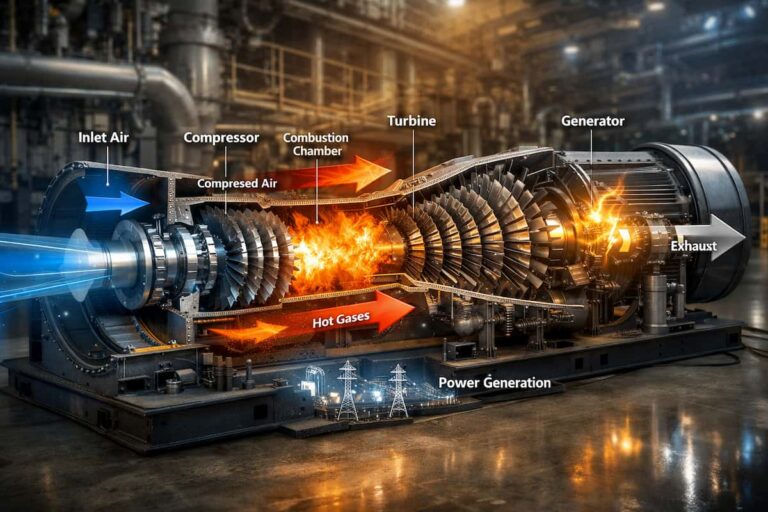
Before selecting a gas turbine temperature sensor, one must acknowledge the extreme physical stressors present within the turbine casing. Unlike standard industrial applications, turbine internals represent one of the most hostile environments in modern engineering.
Extreme Heat and Thermal Cycling
The hot gas path of a modern turbine can exceed 1,600°C (2,912°F). While the components themselves are often cooled by compressor bleed air, the sensors must withstand both the baseline heat and the rapid thermal shock that occurs during startup, load changes, and emergency shutdowns. Material expansion and contraction can lead to fatigue in sensor housings and brittle failure in internal wiring.
High-Frequency Vibration
Turbines operate at high rotational speeds, creating a constant spectrum of vibration. Sensors mounted on the casing or within the flow path are subject to harmonic resonances that can shake internal connections loose or cause mechanical fatigue in the probe sheath. A sensor that is not specifically ruggedized for vibration will provide intermittent data or fail entirely within weeks of installation.
Corrosive Combustion Gases
The combustion of natural gas or liquid fuels releases a cocktail of corrosive elements, including sulfur and vanadium compounds, along with high-velocity particulate matter. These conditions can cause oxidation and erosion of the sensor tip, leading to “drift”: where the sensor reports a temperature that is no longer accurate: or complete penetration of the protective sheath.

Key Factors in Choosing a Turbine Sensor
When upgrading your turbine instrumentation, selecting a sensor based on price alone is a high-risk strategy. Engineering teams must evaluate four critical parameters to ensure the chosen component can maintain its integrity over thousands of operating hours.
1. Temperature Range and Accuracy Tolerances
The first step is identifying the specific measurement point. Is the sensor for exhaust gas temperature (EGT), wheel space monitoring, or the compressor discharge?
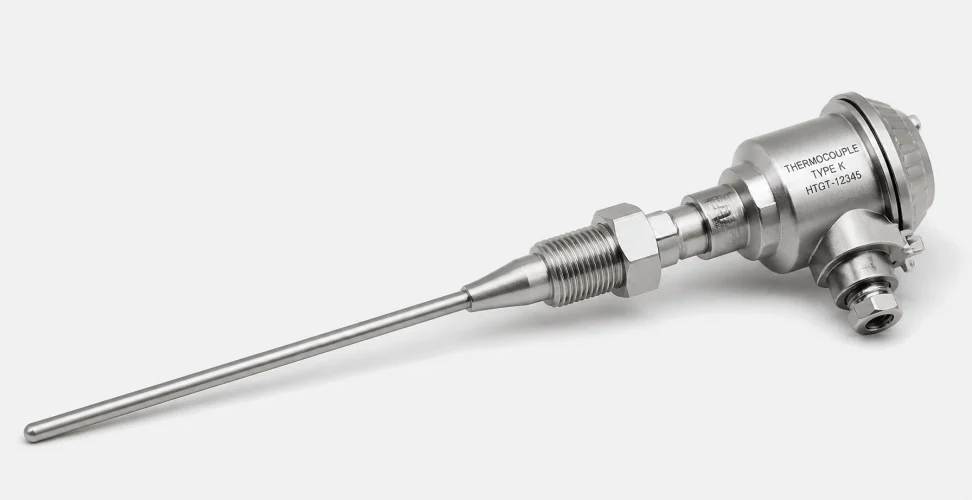
- Type K and Type N Thermocouples are common for moderate temperatures.
- Type S, R, and B (Platinum/Rhodium) are required for the extreme temperatures of the hot gas path.
Accuracy is paramount. Even a 1% drift in temperature reporting can lead to the control system over-firing the turbine, significantly reducing the life of the buckets and nozzles. Ensure your provider offers sensors that meet or exceed original OEM specifications for accuracy.
2. Response Time
In the event of a flameout or a surge, the control system needs data instantly. The response time of a sensor is determined by its mass and the thickness of its protective sheath. While a thicker sheath offers better durability, it creates thermal lag. Selecting the right balance: often through a “tapered-tip” design: is essential for sensors used in critical control loops where safety-trip response times are measured in milliseconds.
3. Mechanical Ruggedness and Vibration Resistance
A reliable turbine sensor must be built with integrated vibration damping. High-quality sensors utilize mineral-insulated (MI) cable, where the conductors are packed tightly in magnesium oxide powder within a metal sheath. This construction prevents the internal wires from vibrating against each other, minimizing the risk of short circuits or open loops in high-vibration zones like the exhaust frame or combustion transition pieces.
4. Material Durability and Superalloys
The sheath material must be compatible with the environment. For high-temperature oxidation resistance, look for sensors utilizing Inconel 600 series or specialized stainless steels. In the most extreme environments, ceramic-coated or exotic alloy sheaths may be necessary to prevent material diffusion and erosion.

Why Specialized Gas Turbine Temperature Sensors Matter
Using generic industrial sensors in a gas turbine is a recipe for unplanned downtime. Specialized gas turbine temperature sensors are designed to protect heavy-duty industrial assets from catastrophic thermal failure.
When a sensor fails or drifts, the plant faces two equally dangerous outcomes:
- Under-firing: The turbine produces less power than it is capable of, leading to lost revenue and missed performance targets.
- Over-firing: The turbine runs too hot, causing premature wear on expensive “hot section” components. Replacing a set of fuel nozzles or turbine buckets costs orders of magnitude more than the highest-quality sensor.
By partnering with a strategic supplier like GTS, you gain access to parts that are not only OEM-equivalent in performance but often superior in availability. We understand that in the energy sector, waiting 26 weeks for an OEM sensor is not an option. Our global supply chain is built to provide faster delivery without compromising the rigorous standards required by GE®, Siemens®, and Westinghouse® systems.
Ensuring Quality Through Certification
Reliability in instrumentation is not just a claim: it must be verified. At GTS, our commitment to technical precision is backed by rigorous quality management systems. Choosing a partner with the right credentials ensures that every sensor arriving at your facility has been tested for insulation resistance, calibration accuracy, and hermetic sealing.

Strategic Selection: A Partnership Approach
Selecting the right turbine sensor is more than a procurement task; it is an engineering decision that impacts the bottom line of your entire facility. Maintenance teams must look beyond the part number and consider the operational reality of their specific site.
- Standardize where possible: Using a consistent sensor profile across your fleet simplifies spare parts inventory and training.
- Audit your drift: If you are replacing sensors every minor outage, your current material selection likely cannot handle your operational profile. It may be time to upgrade to a more durable alloy or a different thermocouple type.
- Leverage expertise: Work with suppliers who understand the “why” behind the specification.
GTS provides more than just hardware; we offer a strategic alliance for power plants worldwide. Our 38-year history in the Industrial Equipment & Energy sector means we have seen every failure mode and helped thousands of operators minimize risk through better part selection.

Conclusion: Securing Your Turbine’s Future
The sensors in your gas turbine are the “eyes and ears” of your operation. When you choose high-quality, OEM-equivalent instrumentation, you are investing in the longevity of your turbine and the safety of your personnel.
Don’t let a secondary component cause a primary failure. Whether you are performing a planned hot-gas-path inspection or responding to an unexpected instrumentation fault, GTS has the technical inventory and the global logistics network to keep your plant running at peak efficiency.
Ready to upgrade your monitoring capabilities?
Explore our full range of heavy-duty industrial instrumentation, including thermocouples, pressure sensors, and vibration monitors, directly on the GTS Sensors Page. Our team is ready to provide technical consultations to ensure you select the exact sensor required for your specific turbine model and operating environment.
For more insights into maintaining your assets, read our guide on 7 Common Turbine Maintenance Mistakes or learn about the benefits of OEM-Equivalent vs. OEM parts.