A turbine bearing failure rarely begins with a dramatic event. It often starts with a small change in lubrication, temperature, alignment, vibration, or contamination levels. If that change goes undetected, the result can be severe: rotor damage, secondary component failure, emergency maintenance, and an extended loss of generation.
For plant managers and maintenance engineers, bearings should be treated as critical turbine components: not routine consumables. They support rotating assemblies, control radial and axial movement, maintain rotor stability, and protect the efficiency and safety of the entire machine.
A proactive bearing strategy can prevent avoidable shutdowns, reduce repair costs, and improve turbine availability.
Why bearing failures create high operational risk
Gas and steam turbines operate under demanding conditions. High rotational speeds, thermal cycling, fluctuating loads, oil-system dependencies, and tight clearances place continuous demands on bearings and related components.
When a bearing begins to deteriorate, the problem can quickly affect:
- Rotor alignment and dynamic stability
- Lubricating oil temperature and pressure
- Shaft vibration and clearance
- Seals, deflectors, and adjacent housings
- Accessory gear and thrust systems
- Turbine output, efficiency, and operating safety
The failure may involve a main bearing, thrust bearing, accessory gear bearing, oil seal, air seal, or deflector. In each case, delayed action increases the likelihood of secondary damage.
Research on turbine bearing reliability consistently identifies lubrication problems, contamination, wear, overload, misalignment, and vibration as major contributors to premature failure. A review published in Polymers also notes the strong relationship between bearing reliability and lubrication condition, including insufficient lubrication, lubricant deterioration, and contamination.[^1]
The most common turbine bearing failure modes
1. Oil starvation and lubrication breakdown
Lubrication separates moving surfaces and carries away heat. When oil flow, pressure, viscosity, or distribution is inadequate, the protective film can become too thin. Metal-to-metal contact then increases friction and surface temperature.
Oil starvation can result from:
- Low oil level or insufficient supply pressure
- Blocked filters, orifices, or feed passages
- Incorrect oil viscosity
- Poor oil distribution during startup or transient operation
- Excessive operating temperature
- Degraded or oxidized lubricant
- Incorrect lubrication intervals
The resulting damage may include scoring, wiping, smearing, micropitting, and accelerated wear. In severe cases, the bearing surface can lose its load-carrying capability.
The business impact is immediate: higher temperatures and vibration can force a protective trip before the maintenance team has time to schedule a controlled intervention.
2. Misalignment and improper installation
Bearing alignment is directly connected to rotor stability. Misalignment can create uneven loading, edge loading, shaft deflection, and localized stress concentrations. It may originate from installation errors, foundation movement, thermal growth, coupling issues, or housing distortion.
Common installation-related problems include:
- Incorrect fits or clearances
- Improper torque on bearing housing fasteners
- Damaged raceways during handling
- Incorrect shimming
- Rotor-to-bearing alignment errors
- Failure to account for thermal expansion
Misalignment often produces a gradual increase in vibration and temperature rather than an immediate failure. That makes trend analysis essential during gas turbine maintenance.
3. Vibration, rotor instability, and dynamic loading
Vibration is both a warning sign and a potential cause of bearing damage. Rotor unbalance, rubs, resonance, shaft whirl, oil whip, and coupling problems can increase dynamic loads on bearings.
In a gas or steam turbine, vibration may indicate:
- Developing bearing wear
- Rotor unbalance
- Misalignment
- Oil-film instability
- Loose bearing components
- Damaged gears or accessory equipment
- Seal contact or deflector damage
A single overall vibration value is not always enough. Maintenance teams should review frequency spectra, phase relationships, shaft position, bearing metal temperature, and operating load together. Pattern changes often provide more useful information than an isolated alarm.
4. Contamination and corrosion
Even small quantities of dirt, water, metal particles, or degraded lubricant can damage precision bearing surfaces. Hard particles can indent raceways and rolling elements. Water can reduce lubricant performance and promote corrosion. Wear debris can circulate through the oil system and accelerate damage in other turbine components.
Contamination can enter through:
- Poorly sealed housings
- Damaged oil seals or air seals
- Open containers and improper oil-handling practices
- Inadequate filtration
- Maintenance activities performed in an unclean environment
- Moisture ingress during storage or operation
Oil cleanliness should be managed as a reliability requirement. Filter condition, particle counts, water content, viscosity, and wear-metal trends should be reviewed according to your turbine manufacturer’s requirements and site procedures.
5. Normal wear, fatigue, and clearance growth
Bearings are designed for long service, but fatigue and wear eventually affect all rotating equipment. Surface fatigue may appear as micropitting, spalling, cracking, or flaking. General wear can increase internal clearance and reduce rotor control.
For turbines operating at high temperature, material selection and heat treatment are especially important. Bearing materials must withstand repeated loading, thermal cycling, and the operating environment. In some applications, material properties such as hardness, steel cleanliness, surface finish, and resistance to creep or thermal distortion can directly influence service life.
Early warning signs your team should monitor
A reliable condition-monitoring program combines multiple indicators. No single measurement provides a complete diagnosis.
Watch for:
- Rising bearing metal or oil outlet temperature
- Increasing overall vibration or new spectral peaks
- Changes in shaft position or rotor axial movement
- Unusual rumbling, growling, or mechanical noise
- Oil pressure or flow deviations
- Darkened, degraded, or contaminated lubricant
- Increased iron, copper, or other wear metals in oil analysis
- Repeated alarms during startup, shutdown, or load changes
- Unexpected changes in turbine efficiency or output
When an alarm occurs, do not simply reset it and return the unit to service. Compare the current trend with historical operating data. Confirm sensor health, review recent maintenance, inspect lubrication parameters, and assess whether the condition is progressing.
How to prevent turbine bearing failures
Build condition monitoring into the maintenance strategy
Online vibration monitoring, temperature measurement, oil analysis, and shaft-position monitoring should support one another. Establish normal operating baselines for each bearing and define escalation thresholds before an alarm occurs.
A practical program should include:
- Continuous or periodic vibration trending
- Bearing and lube-oil temperature monitoring
- Oil pressure and flow verification
- Laboratory oil analysis at defined intervals
- Inspection of filters and magnetic debris collectors
- Review of startup and shutdown data
- Root-cause analysis after every bearing-related alarm
This approach empowers your team to schedule parts, labor, and outage work before a developing fault becomes an emergency.
Control lubrication carefully
Use the lubricant specified for the bearing design and operating conditions. Confirm viscosity, additive compatibility, temperature range, and seal compatibility. Do not mix lubricants without technical approval.
Good lubrication control includes:
- Maintaining correct oil level, flow, and pressure
- Replacing or cleaning filters at the required intervals
- Protecting oil from water and airborne contamination
- Verifying lubrication lines and nozzles are clear
- Sampling oil from representative points
- Adjusting lubrication practices based on condition data
More lubricant is not always better. Over-lubrication can increase churning, heat generation, seal loading, and leakage. Follow the equipment-specific procedure rather than relying on a generic interval.
Confirm alignment and installation quality
Precision installation is as important as part quality. Use calibrated tools and documented procedures for fits, clearances, torque, shimming, shaft alignment, and runout checks.
During an outage, inspect adjacent components rather than replacing only the visibly damaged bearing. Check the shaft, housing, seals, deflectors, oil passages, coupling, gears, and thrust-control surfaces. The original failure may have started elsewhere.
Selecting OEM-equivalent replacement bearings
When replacement is necessary, dimensional similarity alone is not enough. A suitable OEM-equivalent bearing should be evaluated against the turbine’s operating requirements and the original component specification.
Your procurement and engineering review should confirm:
- Correct geometry and envelope dimensions
- Radial and axial load capacity
- Internal clearance and fit requirements
- Material and heat-treatment characteristics
- Surface finish and coating requirements
- Lubrication compatibility
- Temperature and speed capability
- Traceability and inspection documentation
- Compatibility with the relevant turbine model and configuration
The same principle applies to related turbine components, including oil seals, air seals, deflectors, accessory gear bearings, and accessory thrust bearings. Replacing one component without checking the complete assembly can leave the original failure mechanism unresolved.
How GTS supports faster turbine maintenance
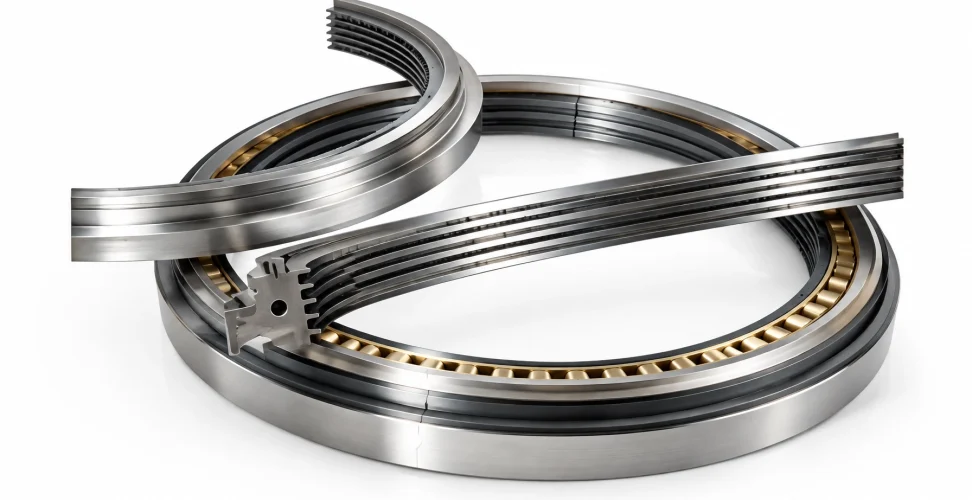
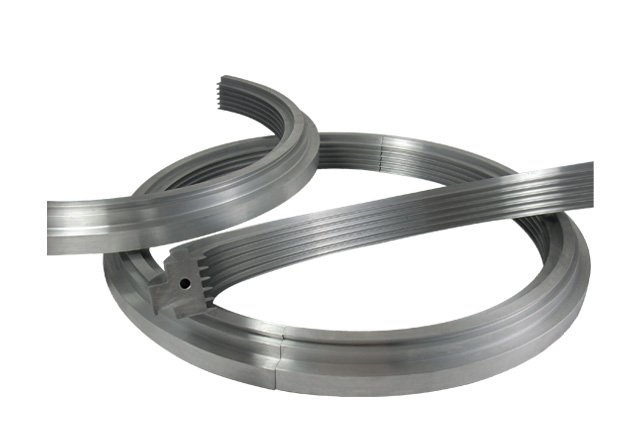
Global Tech Services, LLC supplies OEM-equivalent bearings and deflectors for gas turbines, including:
- Oil seals
- Air seals
- Deflectors
- Accessory gear bearings
- Accessory thrust bearings
GTS helps power-generation facilities, industrial plants, and energy companies navigate urgent maintenance requirements with competitive pricing, complete parts availability, and faster delivery than typical OEM channels.
Our team can support your sourcing process by reviewing turbine model information, part numbers, drawings, and application requirements. Explore the GTS bearings and deflectors range or review our broader turbine parts portfolio.
Protect your next operating cycle
Bearing failures are preventable more often than they are unavoidable. The strongest results come from combining condition monitoring, disciplined lubrication, contamination control, precision alignment, and dependable replacement parts.
If your plant is planning an outage, investigating abnormal vibration, or preparing for a bearing replacement, contact GTS for a technical consultation. Our team can help you identify the right bearings, deflectors, seals, and related turbine components to minimize downtime and protect your operating schedule.
[^1]: Han Peng et al., “Review of Tribological Failure Analysis and Lubrication Technology Research of Wind Power Bearings,” Polymers, 2022. Read the research review.