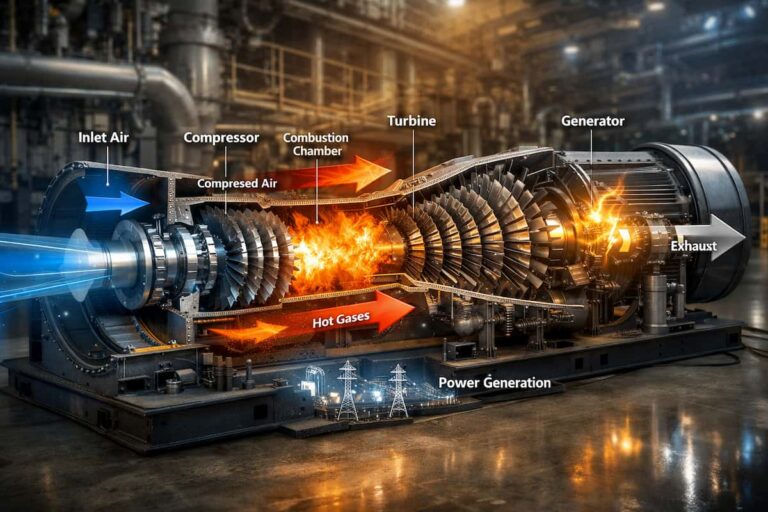
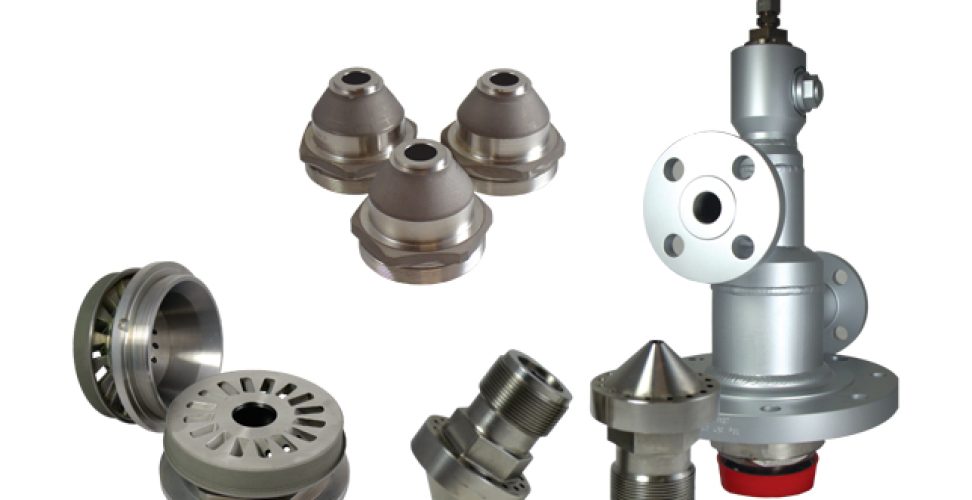
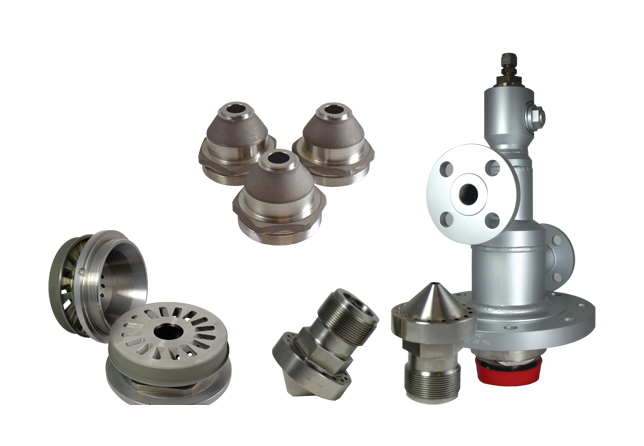
A fuel nozzle assembly is a relatively small component within a gas turbine fuel system. Its impact on plant performance is far larger than its physical size suggests.
When a nozzle becomes restricted, eroded, cracked, poorly calibrated, or improperly assembled, the immediate problem may appear to be a replacement-part expense. The actual financial exposure can be much greater. Fuel nozzle assembly failure can reduce combustion efficiency, increase emissions, trigger an unplanned outage, and accelerate damage across the hot gas path.
For plant managers, maintenance teams, and procurement departments, the right response is not simply replacing a failed nozzle. It is identifying degradation early, maintaining balanced fuel flow, and sourcing a reliable replacement before a localized defect becomes a system-wide event.
Why the Fuel Nozzle Assembly Matters
The fuel nozzle controls how fuel enters the combustor. Depending on the turbine design, the assembly may include a nozzle tip, inserts, strainers, fuel passages, swirler components, check valves, and associated hardware.
Together, these components must:
- Meter fuel at the required flow rate
- Atomize liquid fuel into an appropriate spray pattern
- Support consistent fuel-air mixing
- Maintain stable combustion across the combustor
- Protect against internal leakage and unwanted flow changes
- Operate under high temperature, pressure, vibration, and corrosive conditions
The fuel nozzle assembly must perform consistently across the entire operating range. Small variations in orifice geometry, internal leakage, spray pattern, or fuel distribution can create significant temperature differences inside the combustor.
That is why nozzle condition is directly connected to gas turbine efficiency, emissions performance, hot gas path life, and outage planning.

Hidden Cost 1: Combustion Efficiency Losses
A degraded fuel nozzle does not always fail suddenly. In many cases, performance declines progressively.
Carbon buildup, partial blockage, erosion, tip burning, or internal leakage can alter the intended fuel flow. Instead of producing a consistent spray, the nozzle may create streaking, poor atomization, or an uneven fuel-air mixture.
This can lead to:
- Incomplete combustion
- Higher fuel consumption for the same power output
- Reduced turbine load capability
- Increased exhaust temperature spread
- Combustion instability
- Smoke or visible exhaust abnormalities
- Failed starts or flameout conditions in severe cases
When one nozzle delivers too much fuel and another delivers too little, the combustor no longer operates uniformly. Some sectors may run fuel-rich while others run fuel-lean. The turbine controls may compensate within a limited range, but compensation can reduce operating flexibility and efficiency.
The hidden cost is the energy wasted before the nozzle is identified as the root cause. Even a modest efficiency decline can become material when a turbine operates continuously and fuel prices are elevated.
For a plant manager, the business impact may appear as a higher heat rate, reduced output, or lower operating margin. For the maintenance team, it may initially appear as an exhaust temperature or combustion tuning issue rather than a fuel nozzle assembly problem.
Hidden Cost 2: Unplanned Outage Exposure
Fuel nozzle failures can force an operator to derate or shut down a turbine. The cost of the replacement part is then only one line item in a much larger outage calculation.
An unplanned outage may involve:
- Lost generation or production revenue
- Emergency labor and contractor premiums
- Expedited freight and customs costs
- Additional inspection and diagnostic work
- Replacement of related gaskets, seals, hoses, and hardware
- Dispatch penalties or contractual exposure
- Delayed scheduled maintenance activities
- Secondary damage to combustor or hot gas path components
The commercial impact depends on the facility, power market, turbine size, operating profile, and outage duration. However, the principle is consistent: a low-cost critical spare can prevent a high-cost operational interruption.
Maintenance teams should avoid treating fuel nozzle assemblies as ordinary consumables. They are critical-path components. If the required assembly is unavailable when inspection findings are confirmed, the turbine may remain offline while procurement teams search for a suitable part.
A planned replacement gives you control over labor, logistics, testing, and installation. An emergency replacement gives the failure control over your schedule.
Hidden Cost 3: Emissions and Compliance Risk
Fuel nozzle condition also affects emissions performance.
Localized over-fueling and hot combustion zones can increase thermal NOx formation. Poor atomization and incomplete combustion can increase carbon monoxide and unburned hydrocarbons. These changes may push the turbine outside its expected emissions profile.
Not every fuel nozzle issue results in a regulatory violation. However, nozzle degradation can contribute to:
- Increased NOx readings
- Higher CO and unburned hydrocarbon emissions
- More frequent combustion tuning requirements
- Failed emissions tests
- Derating to remain within permit limits
- Additional environmental reporting or corrective action
- Potential fines or lost operating flexibility
Modern low-emissions combustion systems depend on carefully controlled fuel distribution. A small change in flow balance can affect the combustion dynamics of the entire system.
For operators working under strict air permits, emissions data should be treated as an early-warning signal. A rising NOx or CO trend, combined with a changing exhaust temperature spread, may indicate fuel nozzle degradation before a visible failure occurs.
Maintaining emissions compliance is not separate from maintenance reliability. It is part of the same fuel system risk-management strategy.
Hidden Cost 4: Downstream Hot Gas Path Damage
The most serious consequence of fuel nozzle assembly failure may occur downstream.
An uneven spray pattern can produce a hot streak that exposes selected areas of the combustor liner, transition piece, first-stage nozzle, buckets, or shrouds to excessive temperature. Over time, this can accelerate:
- Thermal fatigue
- Oxidation
- Hot corrosion
- Coating degradation
- Cracking
- Distortion
- Creep damage
- Premature component replacement
Creep is especially important in high-temperature turbine environments. Small increases in metal temperature can significantly reduce the service life of superalloy components. A nozzle defect that appears minor during an initial inspection can therefore shorten the life of expensive hot gas path parts.

When a fuel nozzle problem is allowed to continue, the repair scope may expand from a nozzle replacement to a combustion inspection, transition-piece repair, first-stage nozzle replacement, bucket evaluation, or a complete hot gas path outage.
Protecting the fuel nozzle assembly protects the components that follow it.
Common Fuel Nozzle Assembly Failure Modes
A focused inspection program should account for the most common causes of nozzle performance loss:
- Coking and carbon deposits: Deposits restrict flow and distort the spray pattern.
- Orifice blockage: Contaminants or deposits reduce the effective flow area.
- Erosion: Fuel quality, particulates, and operating conditions can change critical internal dimensions.
- Tip burning: Flame attachment or inadequate cooling can damage the nozzle tip.
- Cracks and braze failures: Cracks may create internal leakage or disrupt cooling circuits.
- Check valve problems: A compromised check valve can affect fuel isolation and flow stability.
- Improper assembly: Incorrect parts, damaged seals, or incorrect torque can change performance.
- Fuel contamination: Water, solids, and other contaminants can damage pumps, filters, and nozzle passages.
The correct response depends on the failure mechanism. Cleaning alone may not correct erosion or cracking. Replacement may not address a contaminated fuel supply or a failing check valve. Root-cause analysis is essential.
How to Detect Problems Before They Become an Outage
Your maintenance strategy should combine operating data, inspection findings, and parts planning.
Monitor the following indicators:
- Exhaust temperature spread
A developing hot or cold sector may indicate fuel maldistribution. - NOx, CO, and hydrocarbon trends
Changes in emissions can point to poor atomization or uneven combustion. - Fuel pressure and flow behavior
Abnormal pressure differences can indicate restrictions, leakage, or control issues. - Combustion dynamics
Unusual pulsations, instability, or startup behavior should receive immediate attention. - Borescope and visual inspection results
Look for carbon deposits, burning, cracking, distortion, and abnormal discoloration. - Flow testing and calibration data
Bench testing confirms whether assemblies meet the required flow balance and performance criteria.

Inspection intervals must follow the turbine manufacturer’s requirements and your site’s operating conditions. Units operating on liquid fuel, in dusty environments, or under frequent cycling may require additional attention.
Smarter Sourcing Reduces the Total Cost of Failure
When a fuel nozzle assembly requires replacement, sourcing speed and technical fitment matter.
An inexpensive part that does not meet the required geometry, metallurgy, tolerances, or flow characteristics can create a second failure. Conversely, waiting months for an OEM part may extend an outage and increase lost-production costs.
A high-quality OEM-equivalent solution should be evaluated against:
- Compatibility with the specific turbine model and configuration
- OEM specifications and required dimensional tolerances
- Material suitability for high-temperature service
- Flow characteristics and spray-pattern requirements
- Quality-control documentation
- Inspection and testing procedures
- Availability of associated seals, hoses, check valves, and hardware
- Delivery capability for planned and emergency requirements
GTS supplies OEM-equivalent fuel nozzle assemblies and fuel system components for major gas turbine platforms, including systems associated with General Electric®, Siemens®, Westinghouse®, and Nuovo Pignone®. Our range includes fuel nozzle assemblies, nozzle components, flexible metal hoses, check valves, and fuel pumps.
By combining competitive pricing with faster delivery and complete parts availability, GTS helps maintenance teams minimize procurement delays without compromising reliability.
Explore the GTS fuel system components range or contact GTS to discuss your turbine requirements.
Build a Fuel System Partnership Before Failure Occurs
The most effective fuel nozzle strategy is proactive. Identify critical assemblies, establish inspection criteria, maintain appropriate spares, and confirm a response path before the next outage.
A strategic alliance with a qualified parts supplier can help you:
- Reduce emergency procurement risk
- Improve outage readiness
- Protect combustion efficiency
- Support emissions compliance
- Minimize hot gas path damage
- Extend maintenance intervals
- Lower total cost of ownership
The replacement price of a fuel nozzle assembly is only part of the equation. The larger cost is the efficiency loss, outage exposure, emissions risk, and downstream damage that can follow a preventable failure.
GTS is ready to support your maintenance and procurement teams with reliable OEM-equivalent fuel nozzle assemblies, complementary fuel system components, and responsive global delivery. Contact GTS for a technical consultation and develop a sourcing strategy that protects your turbine’s performance and your maintenance budget.