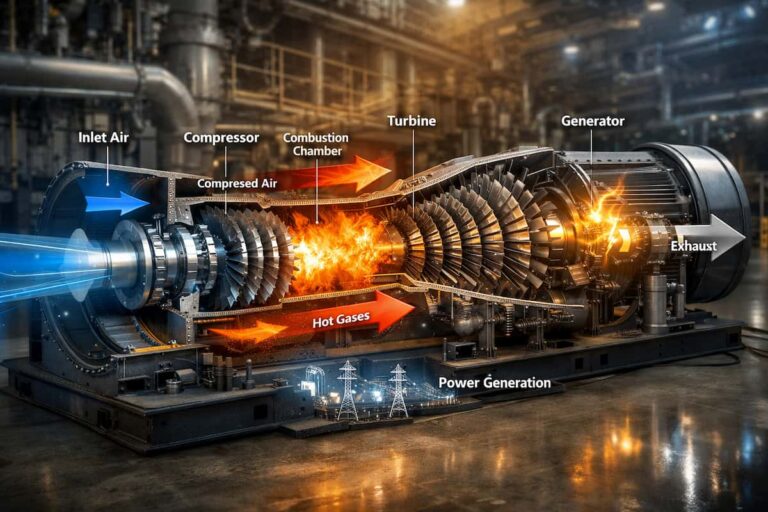
Turbines ordered today may not arrive before the decade turns. For operators, that market reality collides with outage windows that cannot slip, equipment operating under punishing conditions, and maintenance budgets under pressure.
The pressure is not limited to new-build projects. When an essential replacement part is unavailable, a planned outage can overrun, or an unplanned trip can extend while teams wait for supply. In a tight market, parts availability is a reliability issue, not just a procurement concern.
Industry reporting describes a widening gap between demand and production. Wood Mackenzie reported global gas turbine orders of about 110 GW at the end of 2025, while annual manufacturing capacity was estimated at only 60–70 GW. Its April 2026 outlook projected prices at approximately US$600/kW by the end of 2027, up 195% since 2019. The same report cited lead times of around six years for large turbines, with order books extending through 2027 (Wood Mackenzie).
For plant teams, the priority is clear: reduce dependence on uncertain delivery dates by building a risk-based spares strategy now.
What’s Driving the 2026 Gas Turbine Supply Crunch
The market imbalance reflects several connected pressures. It is not simply a matter of one manufacturer falling behind.
- AI data center electrification is accelerating demand. Power-intensive data centers are driving new generation plans and competing for turbine production slots. Wood Mackenzie forecasts U.S. data-center electricity consumption will increase substantially through 2031, adding urgency to already long equipment queues.
- Aerospace and defense draw on overlapping supply chains. Aviation and defense programs compete for specialized materials, manufacturing expertise, and qualified suppliers. Nickel-based superalloys and cobalt-bearing materials are important in high-temperature applications, though the supply constraint also involves the complex processes and capacity needed to turn materials into certified components.
- Hot-section manufacturing is difficult to scale quickly. Single-crystal blades require precision casting, specialized processes, detailed inspection, and qualification. Large forged parts, including rotors, also depend on limited manufacturing capacity and demanding quality controls.
These components must withstand high temperatures, oxidation, thermal fatigue, and creep. The gradual deformation of material under sustained heat and stress. Expanding an assembly line does not instantly create more qualified blade, forging, coating, or inspection capacity. Oak Ridge National Laboratory has reported that delivery timelines for critical turbines can reach five to seven years in some cases (ORNL).

Why OEM Lead Times Are No Longer a Viable Plan A
OEMs remain important sources of design knowledge, technical support, and proprietary parts. But relying on an OEM queue as the only route to every replacement can expose your plant to schedule risk.
When a delivery date stretches beyond your outage window, the consequences can include:
- Delayed return to service and lost generation
- Emergency freight and higher procurement costs
- Expensive schedule changes for contractors and crews
- Pressure to make rushed substitutions
- Greater vulnerability when a legacy model or less common configuration needs a part
A part with a long lead time can control the schedule for the entire unit. The operational risk can be significant even when the missing item is relatively small.
The goal is not to replace technical diligence with speed. It is to prepare qualified options before a shortage becomes an emergency. GTS’s guide to OEM versus OEM-equivalent turbine parts explains why fit, documentation, materials, and application matter alongside price and availability.
5 Ways Leading Operators Are Buffering the Shock
A resilient sourcing strategy combines inventory, maintenance data, outage planning, and qualified supply options. These five approaches can help your team minimize exposure.
1. Hold buffer inventory for critical spares
Set stock levels according to failure consequence, usage, replenishment time, and budget, not a one-size-fits-all rule. As a starting framework, evaluate one to six months of consumption for selected critical items, then adjust for actual failure history and supplier lead times.
Prioritize parts that are difficult to source and could prevent startup or return to service. Define reorder triggers, storage conditions, and inspection requirements so stocked parts remain ready for use.
2. Evaluate component exchange programs
Where an exchange option is technically appropriate, a repair or exchange arrangement may help reduce the time a unit waits for a component. Confirm eligibility, condition requirements, inspection criteria, warranty terms, and the availability of the replacement before relying on the program in an outage plan.
3. Use predictive monitoring to inform purchasing
Vibration trends, exhaust temperature changes, pressure readings, and inspection findings can help identify developing issues. Connect these signals to procurement: when condition data indicates an increased risk, check stock and lead times early rather than waiting for a failure.

4. Bundle upgrades with planned outages
When engineering and operating requirements support it, coordinate approved upgrades with scheduled maintenance. Bundling work can reduce repeat mobilization and help your team align material needs, labor, and outage scope. Confirm engineering approvals and part compatibility before integrating any change.
5. Qualify OEM-equivalent sources before you need them
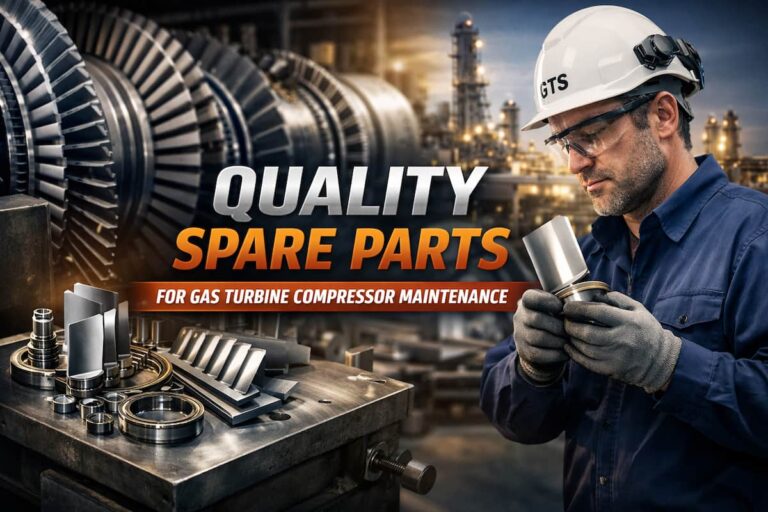
A second source is useful only when it is technically suitable and properly reviewed. For fuel nozzles, rotor and stator blades, bearings, seals, and sensors, verify fitment for your specific turbine and the documentation required by your quality process.
GTS supplies OEM-equivalent turbine components for major brands, including GE®, Westinghouse®, Nuovo Pignone®, and Siemens®. Explore available fuel system components and ask about sourcing options for your unit and application.
How to Audit Your Spares Vulnerability in One Week
A focused, five-day review can reveal where your outage plan depends on uncertain supply. Involve maintenance, procurement, engineering, and operations so the results reflect both technical and commercial risk.
Day 1: Gather the data. Pull your current spares list, turbine model and frame details, past failure records, outage schedules, purchase orders, and supplier lead-time information.
Day 2: Rank parts by risk. For each part, consider failure frequency × lead time, then add the consequence of failure. Flag items that could prevent startup, safe operation, or completion of planned work.
Day 3: Identify single-source exposure. Mark parts with only one known supplier, uncertain delivery dates, obsolete references, or unclear documentation. Include small but schedule-critical items such as sensors, seals, and installation hardware.
Day 4: Verify model-specific equivalents. Check part numbers, revisions, dimensions, materials, and interfaces against your turbine configuration. Review potential availability for the relevant unit, including Frame 5, 6, or 9, and Siemens V64.3 or V94.2 where applicable. Do not assume that parts are interchangeable solely because they share a manufacturer or frame family.

Day 5: Assign actions and owners. For each high-risk item, decide whether to hold stock, seek an approved alternate, reserve supply, consider an exchange option, or change the outage plan. Record the responsible person and a due date.
The result should be a practical action list, not just a spreadsheet. GTS’s spares supply-chain guide offers further guidance on supplier diversification, cross-referencing, and strategic stocking.
Build Your Supply Strategy Before the Next Outage
The gas turbine supply crunch is putting pressure on equipment delivery, budgets, and maintenance schedules. You may not control manufacturing capacity or global demand, but you can improve how your plant prepares: prioritize critical parts, validate lead times, qualify alternate sources, and connect condition monitoring to procurement decisions.
Global Tech Services, LLC can help your team review requirements and identify in-stock OEM-equivalent components for GE®, Westinghouse®, Nuovo Pignone®, and Siemens® gas and steam turbines, subject to model and part availability.
Contact GTS for a technical consultation to discuss your turbine model, part references, outage timing, and spares priorities. A strategic supply partnership can help your team make informed sourcing decisions, control schedule risk, and protect plant uptime.
GTS is an independent supplier of OEM-equivalent parts and is not affiliated with or endorsed by the referenced OEMs. OEM names and trademarks are used for identification and compatibility purposes only.